Cargo Screening — The Critical Security Layer Behind Global Trade
For many years, global security investment and industry attention has focused heavily on passenger screening environments.
Airports, passenger checkpoints and public access screening have naturally remained a major priority due to the visibility, regulatory pressure and potential consequences associated with aviation security threats.
Yet while passenger screening continues advancing rapidly, another area of the global security landscape has quietly grown in both scale and complexity: Cargo.
Today, the movement of cargo underpins global trade itself. Seaports, logistics hubs, customs facilities, courier networks, bonded warehouses and air cargo terminals process enormous volumes of freight continuously across international borders every hour of every day. Despite this, cargo screening has often remained one of the more overlooked sectors within the wider security industry.
Recent global instability within international shipping routes, ongoing port congestion, vessel disruptions and extended ocean freight lead times have further accelerated this challenge. As supply chains continue adapting, many industries have increasingly shifted toward air freight and expedited cargo movement in order to maintain operational continuity. This has resulted in a significant increase in cargo volumes moving through screening environments globally, placing additional pressure on customs authorities, freight operators and air cargo facilities to process freight rapidly without compromising detection standards.
The operational challenge is immense.
Unlike passenger baggage, cargo presents highly inconsistent screening environments. Freight varies dramatically in density, size, composition and packaging. Screening operators are often required to inspect palletised loads, consolidated freight, industrial equipment, mixed consignments and densely packed shipments under significant operational time pressure.
At the same time, global cargo volumes continue increasing at an unprecedented rate.
E-commerce expansion, international trade growth and modern supply chain demands are placing enormous pressure on customs authorities, freight operators and logistics providers to move cargo faster while maintaining strong detection standards.
This creates a difficult balance between operational efficiency and effective threat detection.
Historically, cargo screening systems were often forced to compromise between throughput and image interpretation capability. Slower systems created operational bottlenecks, while faster workflows could place increased pressure on operators tasked with interpreting highly complex cargo images continuously throughout long operational shifts.
The industry is now entering a new phase.
High-throughput cargo screening environments increasingly require systems capable of combining speed, penetration performance, image clarity and intelligent operator support simultaneously.
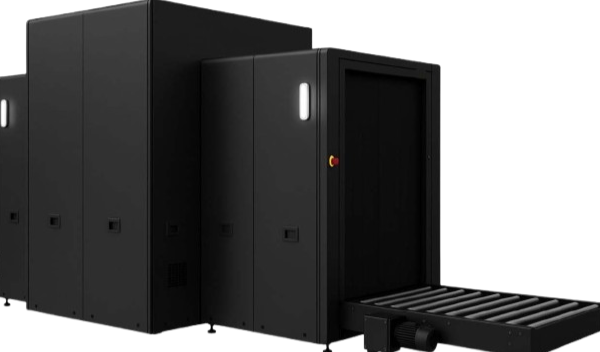
This philosophy continues to drive the development of HISSCO’s HS 1818 Dual View EVO2 platform.
Now deployed globally across multiple high-volume cargo environments, the HS 1818DV EVO2 has been engineered specifically around the realities of modern freight screening operations. Capable of conveyor speeds of up to 0.5 metres per second, the platform represents one of the fastest dual-view palletised cargo x-ray systems available globally within its class.
Available in both 200kV and 320kV dual-view configurations and supported by SACAA and DFT UK approval for use, the system has been designed to support demanding operational environments where both throughput and detection performance remain critical.
The next evolution of cargo screening will extend beyond hardware capability alone.
AI-Assisted Imaging™ is expected to play a major role in reshaping how cargo inspection environments operate moving forward.
HISSCO’s latest AI-Assisted Imaging™ software, currently under final development, focuses specifically on addressing the unique complexities associated with freight inspection. Unlike conventional passenger screening environments, cargo presents vastly greater image variability, density overlap and object inconsistency.
The objective is not simply automation.
The objective is to assist operators in managing increasingly complex screening environments by improving anomaly identification, supporting faster image interpretation and strengthening overall detection capability within high-throughput operations.
As global trade volumes continue accelerating, cargo screening will become an increasingly important component of the broader international security landscape.
The industry’s future will not be defined solely by how effectively people are screened.
It will also be defined by how securely and efficiently the world’s cargo continues to move.
Related Posts